Browse our archives by topic…
Blog
Browse our blogs activity over the years…

FinTech Week and the Microsoft Cloud
To celebrate FinTech Week, we've released an eBook based our our talk about Disruption in Financial Services at Future Decoded.
Machine Learning - mad science or a pragmatic process?
This post looks at what machine learning really is (and isn't), dispelling some of the myths and hype that have emerged as the interest in data science, predictive analytics and machine learning has grown. Without any hard guarantees of success, it argues that machine learning as a discipline is simply trial and error at scale – proving or disproving statistical scenarios through structured experimentation.
Improve Windows Command Prompt and PowerShell experience with ConEmu
Mike Larah shares his tips for how to best customize ConEmu to improve your terminal experience for Windows Command Prompy and PowerShell
Detecting API breaking changes in .NET and suggesting a SemVer number
Exploring the creation of a tool to detect accidental .NET API changes for accurate SemVer in NuGet packages.
SpecFlow 2.0, NUnit3, Visual Studio and TeamCity
We recently upgraded our TeamCity based CI/CD environment, but we had to make some adjustments to fix failing tests.
Developing U-SQL: Local Data Folder
This post explains how to find the local data folder location for running U-SQL scripts locally in Visual Studio, which changed between versions of the Data Lake Tools.
ILMerge Meta-Runner for TeamCity
Meta-Runners allow you to easily create reusable build components for TeamCity, in this post I demonstrate how to create a Meta-Runner to wrap ILMerge functionality.
Azure Resource Manager authentication from a PowerShell script
Learn how to authenticate against Azure Resource Manager using PowerShell, for fully automated deployments.

Endjin.Licensing now supports SHA256
Microsoft have added SHA256 support to Signed XML, and Endjin.Licensing has been updating to take advantage of this breaking change.

Era of the modern browser: market share analysis, January 2016
January 2016 browser stats -- a year on from our first report. Chrome now commands nearly 70% among developers, Edge has appeared at 3%, and IE11 dominates what remains of IE usage at 87%. The era of the modern browser has truly arrived.

Azure Weekly turns 1: giving away 5 Windows IoT Raspberry Pi 2 kits
We've reached our first milestone - a whole year of publishing Azure Weekly. To celebrate we're giving away stuff!
CucumberJS Visual Studio Test Runner
We've built and open-sourced a Visual Studio Extension that provides basic support for discovering and running CucumberJS tests with Node.JS, in the Visual Studio Test Environment.
Thread-safe lazy collection with Lazy & ConcurrentDictionary in C#
In this post, Mike Larah discusses how to ensure your C# collections are thread-safe, only run-once, and are lazy-loaded.

My first month at endjin
A year ago Jess was in a sunny coffee shop in Perth, Australia. Now he's one month into endjin, and his first in-person encounter was in a sushi bar in London.
Azure Batch - Time is Money in Big Compute
Consumption based pricing is a one of the USPs of Cloud PaaS services, but the default settings aren't necessarily optimised for cost. Significant savings can be made from understanding your workload.

Chaos with a rhythm - controlling innovation
Running a start-up or bootstrapping a new product within an established business can feel pretty chaotic. We talk about strategies for managing the time of a team, and ensuring that you become predictable.

Stop coding, start developing your product
Technologists often get hung up on technology and forget about the customer (and the business!) We talk about a real-world example and some practical advice for getting your idea business-focused.
A Step-by-step guide to setting up CucumberJS in Visual Studio 2015
At endjin we love Gherkin for everything from unit tests to UAT. Setting up CucumberJS for JavaScript BDD in Visual Studio 2015 with Grunt is straightforward.
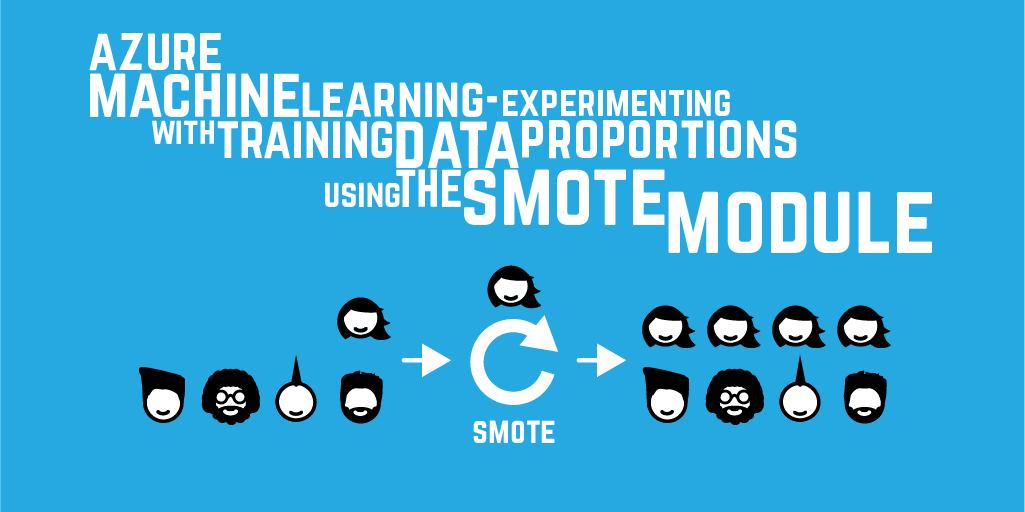
Azure ML: experimenting with training data proportions with SMOTE
Azure Machine Learning's SMOTE module helps balance imbalanced training data by generating synthetic samples, improving model accuracy for multi-class classification.
Bootstrapping product development: Part 10 — Org structures
In the early days of a start up, the organizational structure is defined rather loosely, and typically by function. The technical founder has her domain, the sales & marketing founder his, and they work closely together to achieve their initial goals. As an organization grows, it is not possible to maintain that level of detailed personal control. How does a growing business structure itself for innovation? Or a larger organization pivot and allow an innovation culture to develop?
Azure Resource Manager and PowerShell DSC to create & provision a VM
Explore Azure Resource Manager and PowerShell Desired State Configuration for provisioning and configuring Azure virtual machines.
Spinning up 16,000 A1 Virtual Machines on Azure Batch
We recently completed a technical proof of concept to see if the new Azure Batch service could scale to meet the demands of a Big Compute workload.
Azure data services part 3: Azure Machine Learning
Azure Machine Learning provides a drag-and-drop GUI for building predictive models, then publishes them as web service endpoints: no data science background required to get started.
Azure data services part 2: Stream Insight
Azure Stream Analytics ingests live data through Event Hubs and queries it with a time-aware SQL variant, making it ideal for real-time fraud detection, sensor monitoring, and clickstream analysis.

Azure data services part 1: HDInsight
Azure HDInsight brings Hadoop to the cloud, distributing big data processing across cluster nodes so you can analyse clickstream, financial, or IoT data without maintaining on-premise infrastructure.