Introducing Survive the Sprint: a pixel-art game built (almost) in one shot with Claude Opus 5.5


What happens if you ask an AI model to build a whole game in one go?
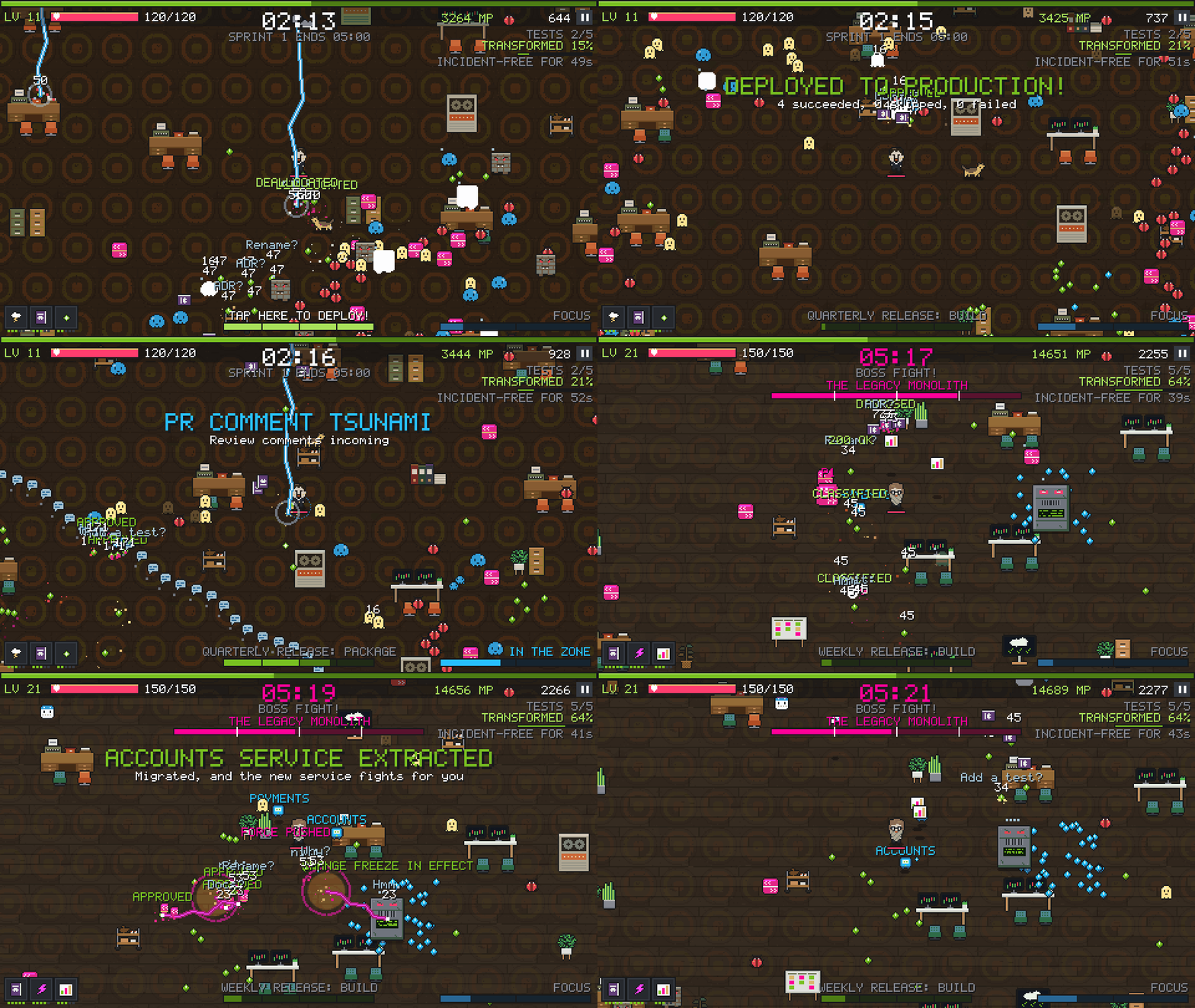
That's the question I set out to answer when I started experimenting with Claude Opus 5.5. The result is Survive the Sprint: a pixel-art, survive-the-horde browser game where you play as one of the endjineers, battling bugs, flaky tests and merge conflicts across three delivery sprints covering our core offerings.
You can play it right now in your browser (it works on your phone too), or watch the promo video first:
Here's how it came together.
The experiment: one prompt, Max effort
Every time a new model comes out, I like to throw something a bit silly at it to see where its limits are. With Opus 5.5, I wanted to try something that would need a lot of different skills at once: game design, rendering, animation, audio, game balance and, ideally, some personality.
So I tried to one-shot a game. I asked Claude to build a pixel-art, browser-based game for endjin, with the endjineers as the playable characters. Rather than describing everyone myself, I pointed it at our Who we are page and let it work out who we all are, what we do, and what we're known for. I ran it on Opus 5.5 with effort set to Max, then left it to get on with it.
What came back was, honestly, far more than I expected. Most of what you see in Survive the Sprint today came out of that single prompt: a complete, playable game in a single HTML file, with no build step and no external assets. The pixel art, the chiptune music and the sound effects are all drawn and generated in code.
Meet the endjineers
The bit that impressed me the most was how much it picked up from the Who we are page.
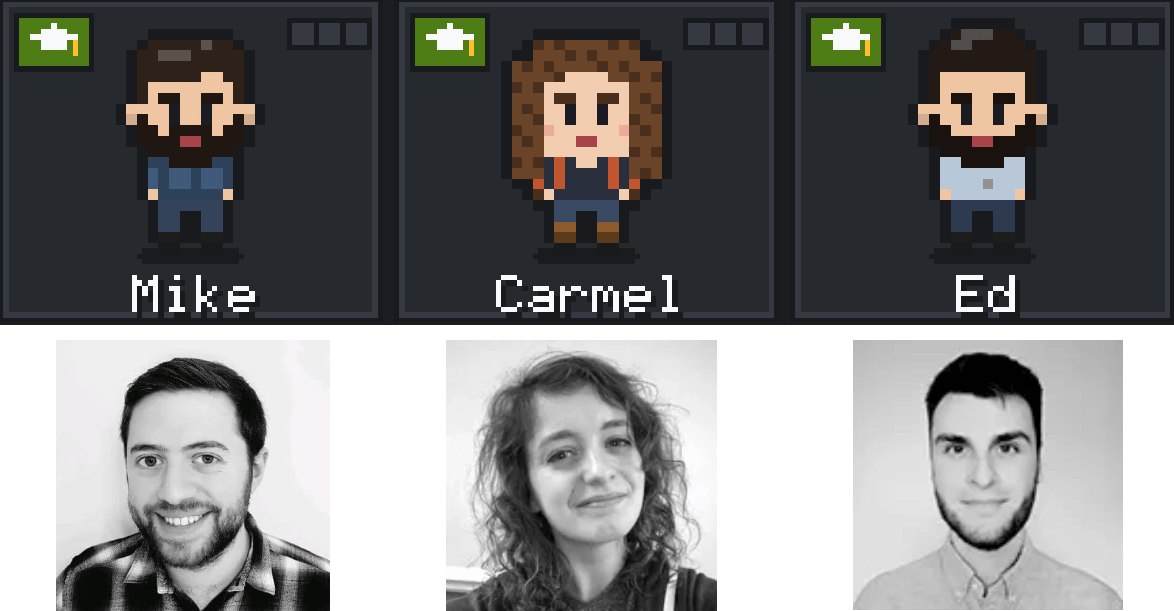
It started with how we look. Claude used the headshots on the page to build a pixel-art sprite for each endjineer, picking out the hair, beards, glasses and clothes that make each of us recognisable. Squeezing someone's face into a handful of pixels and still having them look like them is no small feat. It's easy to spot who's who on the character select screen.
It didn't stop at appearances either. In the original version, each endjineer had their own signature weapon, and many of them were already in-jokes that landed surprisingly well.
Later on, we gave Claude more context about each of us (our quirks, our side projects and the things we're known for in the office), and it used that to add a perk and a special move for everyone too, e.g.:
- Howard van Rooijen calls down an Azure Storm, and his special is the PR Comment Tsunami (anyone who has had a PR reviewed by Howard will understand)
- Ian Griffiths hurls a very thick copy of Programming C# that pierces everything in its path
- Jessica Hill releases pythons that hunt down enemies
- Barry Smart plays the trombone, with regular Slide Blasts
- Ed Freeman lobs exploding bar charts with Dashboard Drop
- Me with Fan-out Functions, and a Getting Things Done perk that fills Focus 30% faster, which is a nice nod to my GTD post
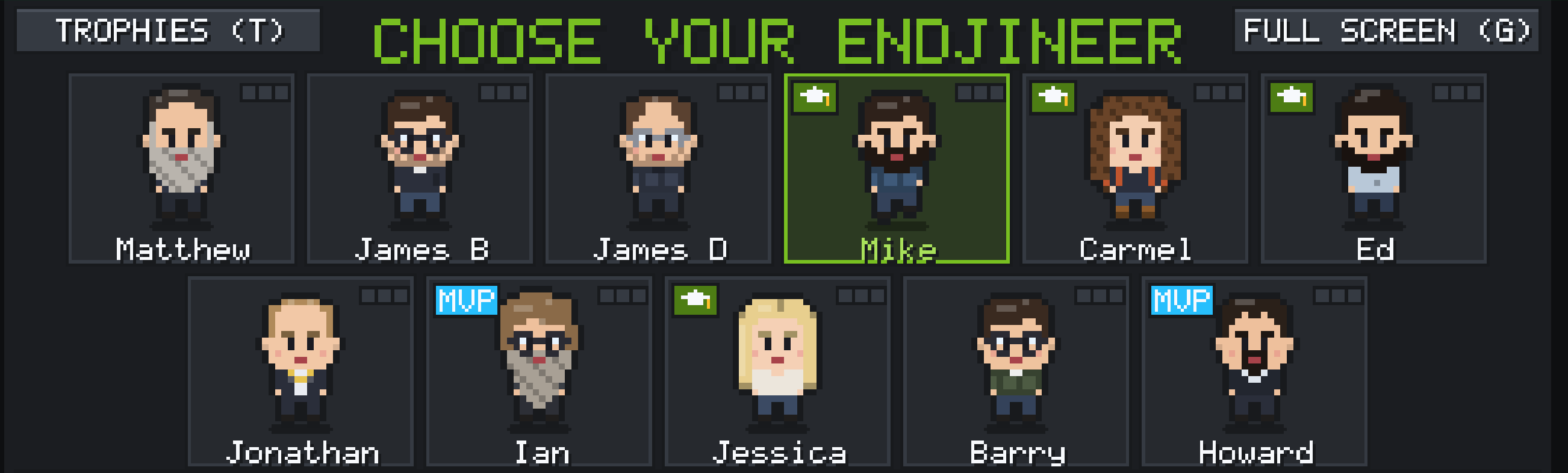
There are eleven endjineers to choose from and the office dogs make an appearance too.
Three sprints, three bosses
Each run takes you through a client engagement that mirrors the kind of work we actually do at endjin:
- The Legacy Migration: cloud native app dev for a financial services client, ending with a fight against The Legacy Monolith
- The Lakehouse: data & analytics for a retailer, where you collect bronze, silver and gold data and take on The Data Swamp
- From Clarity to Production: an AI project for an education client, ending with The Hype Machine
Along the way you level up by collecting Mutual Points (our internal bonus scheme), pick up perks like Mechanical Keyboard, Standing Desk and Off and On Again, pair with colleagues to unlock weapon synergies, and evolve your weapons (In-Memory Cache becomes Multi-Layer Cache, and Neural Network becomes Large Language Model). There are also plenty of achievements to unlock along the way.
From one shot to shipped
I'll admit I was hesitant to share it with the wider team. I had a nagging feeling that the moment it landed in Slack, endjin's productivity would drop like a stone... and I was right.
I sent the original output to Howard first, and he was hooked straight away. From there, we had a fair bit of back and forth with Claude to get it from "impressive demo" to something we were happy to put on endjin.com:
- Tweaks: play-testing the balance, refining the characters and polishing the details
- New features: adding perks and special moves for every endjineer, plus more content and things to discover
- Performance: making sure it stays smooth when the screen is full of enemies, including on mobile
- Bug fixes: the kind of things you only find by actually playing it
- Automated tests: smoke tests, bot playthroughs, layout tests etc.
The important thing for me is that the one-shot gave us a genuinely good foundation to build on. We weren't fighting the code to get changes in; we were just iterating on the fun bits.
Bonus: the promo video
Having previously experimented with getting Claude to create videos, we thought it would be fun to see if it could make a promo video for the game too. It built the whole thing: that's the video at the top of this post.
What I took away from it
A year or two ago, "build me a game" would have got you a bouncing square and a TODO list. With Opus 5.5 on Max effort, a single prompt got us most of a polished, playable game, complete with personality and in-jokes, that we were happy to put our name on.
It still needed people to make it great. Play-testing, taste, and knowing when something isn't quite fun yet are still very much human jobs. But the gap between an idea and a working first version has shrunk dramatically, and that changes what's worth trying.
Go and play it!
Head over to endjin.com/survive-the-sprint, pick your endjineer, and see if you can ship all three sprints. If you manage it with every endjineer, there's an achievement for that too: Bus Factor Eleven.